Minimum Wage Hike: Fewer Jobs, Higher Prices

Newly re-elected Governor Josh Shapiro plans to begin his quest to turn Pennsylvania into East California by doubling the state’s minimum wage. Doing so has been something of a Holy Grail for state legislative Democrats who come January will control both chambers of the General Assembly.
They piously proclaim a minimum wage hike would improve the economic lot of those at the lowest end of the income spectrum, but the real reason is far less altruistic. Shapiro himself gave us a glimpse behind that curtain by forecasting higher state income tax revenue with the bump coming from those earning a higher minimum wage.
A small segment of the state’s workforce – less than 2% — currently earn $7.25 per hour or less. A total of 6.4% are earning between $7.26 – $12.00 per hour with an additional 10.8% earning between $12.01-$15.00 per hour. This is because market pressures have increased wages above the government set minimum as employers compete for qualified employees.
While a minimum wage would have an immediate impact on only a sliver of the workforce it will have a ripple effect pushing wages upward throughout the pay scale. This will be especially true relative to public employee contracts wherein compensation is often negotiated based upon the minimum wage – hence another ulterior motive behind the Left’s push to increase the minimum wage.
Affordability is the currently in vogue buzzword and advocates for an increase in the minimum wage argue – correctly – that nobody can afford to live on the minimum wage. The minimum wage, however, is not intended to be a family sustaining wage. It is an entry level wage designed to give the worker a first step on the employment ladder. It is a training wage that allows workers to gain the soft skills needed to move into a higher paying position.
If the state’s minimum wage is increased by107% as Shapiro is proposing there will be a wide range of unintended consequences. The Keystone Business Climate Survey conducted semi-annually by the Lincoln Institute of Public Opinion Research found 46% of the owners and CEOs of businesses in the commonwealth warning such an increase would have a negative effect on their business. (Most already pay all their employees above minimum wage.)
What does that negative impact look like? In an interview with Fox News Digital Tom Savidge, an economist with the American Institute for Economic Research (AIER) said such sharp increases could force small businesses to raise prices, reduce workers’ hours, or cut back on hiring.
He told Fox News: “It risks higher prices, fewer hours, and fewer jobs, especially for inexperienced workers. Politicians can mandate higher wages, but they cannot mandate that businesses can afford to pay them. Small businesses employing minimum wage workers cannot absorb such a sharp increase without adjusting elsewhere.” He added: “Some may raise prices, cut hours, or stop hiring. A higher minimum wage means little to workers who cannot find a job.”
In fact, that has been the case in California where a Berkeley Research Group study reported 10,700 fast food jobs were lost after that state legislatively mandated a $20 per hour minimum wage for restaurant workers. The use of automation and artificial intelligence tools also increased.
Peter C. Earle of AIER warns raising the minimum wage will have the biggest impact on those it claims to want to help: “One of the most concerning effects of higher minimum wages is their disproportionate impact on marginal workers – those with the least experience, lower skill levels or the greatest barriers to employment.”
He continues: “Young workers, immigrants, and individuals with limited education often struggle the most to secure jobs when wage floors are high as employers prioritize hiring more experienced or higher skilled workers. This creates long-term economic disadvantages, as job seekers are unable to get the experience necessary to move up the career ladder. Additionally, minority and disadvantaged communities are often hit hardest by minimum wage hikes, as they tend to have higher unemployment rates and greater dependence on low-wage jobs for workforce entry.”
Then there is the impact on prices. The inflation rate is already well above the Federal Reserve’s 2% target. Increasing wages will inevitably trigger higher prices. In California, an industry study found local restaurant prices increased by 14.5% following implementation of the higher minimum wage requirement as employers passed roughly 63% of higher labor costs onto consumers.
As with all government tinkering in the free market mandating higher minimum wages will trigger a cascade of unintended consequences. While such a move may be a good talking point for a White House wannabe, the result will be fewer job opportunities and rising prices.
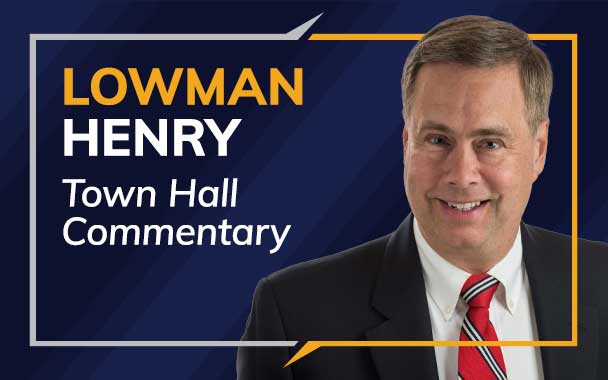
(Lowman S. Henry is Chairman & CEO of the Lincoln Institute of Public Opinion Research and host of the weekly American Radio Journal and Lincoln Radio Journal. His e-mail address is lhenry@lincolninstitute.org.)
Permission to reprint is granted provided author and affiliation are cited.