Is Capitalism Really What Americans are Angry About?

The Democrat Socialists of America are making strong headway into American politics. Socialism is gaining acceptance in almost incomprehensible ways. To ignore these trends or to minimize the potential impact of this movement are to be to our own detriment and, in the worst case, our demise as a free nation.
When I was a member of the PA House of Representatives, I, a very conversative Republican, was assigned a seat on the Democrat side of the aisle because of our significant majority in the House. I had a front row seat to this transition of the Democrat party to an extreme version scoring primary victories today. I watched the other side morph from liberal to socialist to leaning Communist in just 5 years. “Blue Dog” Democrats were targeted, and the battle lines were drawn within the Democrat caucus. Nothing slowed down the transition, and we are, as nation, where we are today.
The transition of the Democrat party is mindboggling but it is our own disbelief in this change that is fueling this explosive growth in socialism. Only by acknowledging the reality of the economic conundrum that we face can we overcome it.
The United States has not operated a purely free-market economy for generations. To believe otherwise is sheer fantasy.
Especially since the Great Depression, Americans have repeatedly decided that there are consequences of free markets that society seemed unwilling to accept. We created protections for bank depositors and retirees. We regulated financial institutions and utilities. We subsidized activities we considered important. We developed government-supported systems for housing, education, healthcare and agriculture. We created environmental and workplace protections. We built social safety nets. We empowered a central bank to play an increasingly important role in economic stability.
These actions did not abolish capitalism, but they modified it. It built the “regulatory state”. But each “fix” changed incentives, prices, risks or choices somewhere in the economic system and over nearly a century, those changes accumulated.
What emerged was not laissez-faire capitalism but a regulated economy masquerading as capitalism. It became an American economic hybrid that an uninformed public is told is still capitalism and that’s what gives the Democrat Socialists a foothold.
We have become accustomed to the fact that when a market produces an outcome society deems as unacceptable than government intervenes. The intervention may or may not improve the original problem but almost always creates an unintended consequence.
The public experiences the unintended consequence but no longer remembers the policy that helped create it. Because businesses are involved, the problem is described as a
failure of capitalism and government is then asked to intervene again. The cycle merely repeats itself.
Perhaps the next intervention helps but the answer seems to be to add more government with our citizens failing to understand that more government is what probably caused the failure that are attempting to fix.
Free markets and competition can create extraordinary innovation and prosperity, but sometimes, markets can impose costs upon people who never agreed to bear them. Information is not always equally available. And what economists politely call “creative destruction” can be devastating to the family whose job, business or community is being destroyed.
A theory that ignores those consequences simply because the market eventually reallocates resources may be economically elegant but politically and socially unrealistic.
You do not need an economics degree to sense it. Families see the cost of housing, healthcare, education and everyday necessities rising faster than they are able to afford. Working families may earn more yet still feel financially squeezed. Most Americans do not share in the massive financial gains on Wall Street. Such gains literally mean nothing to them.
Young adults wonder whether they will enjoy the same economic opportunities their parents had. They see a college degree leaving them with massive debt and no rational way to pay it off.
Businesses confront costs and uncertainties that ultimately affect where they invest and whom they hire. They see government in urban areas treat them like a parasite. Profit is condemned and retail theft in encouraged by elected officials.
The frustration is real. Federal Reserve surveys continue to show affordability pressures in American households, while healthcare affordability remains one of the issues Americans most frequently identify as a major national problem.
The villain to the left is capitalism. They market “tax the rich” “Oligopoly” “tax the billionaires” “wealth tax”. In decades prior, political consultants would have cautioned any candidate to stay away from such arguments because the average citizen saw such wealth in their future but that it no longer the case.
No economic theory deserves unquestioned loyalty. Adam Smith understood something in 1776 that remains fundamental today. People make choices. They respond to incentives. They specialize. They exchange with one another. Competition disciplines behavior. Prices communicate information about scarcity and value in ways no central authority could hope to reproduce perfectly. Those insights helped form the intellectual foundation of capitalism.
But America in 2026 bears little resemblance to Smith’s eighteenth-century world. Capital can cross borders almost instantaneously. Companies can locate operations among
competing states and nations. Highly skilled workers can move. Intellectual property can move. Investment can move.
An economy is not a machine whose pieces remain stationary while policymakers adjust the controls. Human beings make choices. Government can change a tax rate, but it cannot require investment behavior to remain unchanged afterward. Government can increase a subsidy, but it cannot guarantee that producers will leave their prices unchanged. Government can impose a new cost on an employer, but it cannot order that employer to hire exactly the same number of workers and the list goes on.
Markets create incentives. Government changes incentives. People respond to incentives. Any analysis that ignores one of those three is incomplete which brings us to the frustration Americans are feeling today.
Americans have legitimate concerns. People who did what society asked—worked, saved and behaved responsibly—sometimes wonder why the economic system seems to reward speculation more generously than patience.
These concerns are not imaginary, but dissatisfaction is not diagnosis and calling all these outcomes “capitalism” is no more useful than blaming government except when people do not understand either.
To defeat the rise of communism and the Democrat Socialist agenda, the messaging has to center around the failure of intervention and put it in relatable terms for people or retail politics at its best. On Fox Business recently, Maria Bartiromo was interviewing a very successful grocery store owner about the “city run grocery stores” in New York City. He, in 15 seconds, summed up the messaging precisely when he noted that if New York City eliminated his need to pay property taxes and relieved him of the same regulatory burdens that city owned grocery stores will get, he too could lower ALL prices in his stores by 20% with no government ownership and greater consumer choice.
Work at McDonald’s, drive a garbage truck, no tax on tips, just talk with people in terms they feel and understand and this battle will be won.
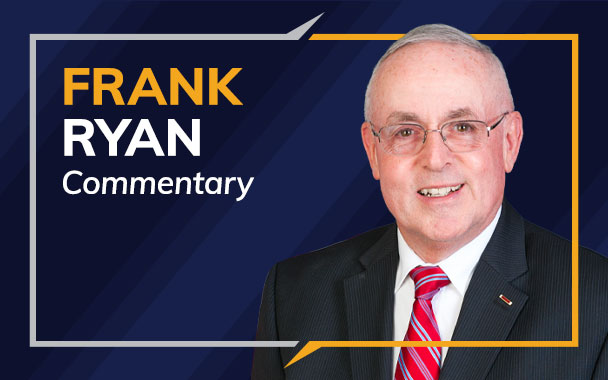
Frank Ryan is a CPA, retired U.S. Marine Corps Reserve Colonel, former member of the Pennsylvania House of Representatives, and former Vice Chair of the Pennsylvania Public School Employees’ Retirement System (PSERS).