Confronting an AI Development with the Founders’Vision

As America approaches the 250th anniversary of the Declaration of Independence, we’re seeing renewed interest in our founding principles and what the founders might think of the nation’s challenges today. Their insights remain surprisingly relevant, and I suggest we might consider how their perspectives on freedom and virtue might influence some of the debates around artificial intelligence.
I have suggested before that two pillars undergirded the American Revolution: sovereignty in the people and God-given inalienable rights that even democratic government cannot revoke. The Declaration of Independence explicitly references the Creator from whom these rights flow and the natural laws tied to that Creator.
Because the founders envisioned limited government, they understood citizens needed to be virtuous. John Adams recognized that maximum freedom under our system required a moral and religious citizenry. George Washington counseled that “of all dispositions and habits which lead to political prosperity, religion and morality are indispensable supports.” Yet the founders were realistic about human nature. James Madison wrote in Federalist No. 51 that “if men were angels, no government would be necessary.”
The founders understood humanity in terms of right and wrong, good and evil. They recognized our capacity for both virtue and vice.
Next year’s 250th anniversary offers a timely opportunity to observe how our founding principles might guide the adoption of new technologies, particularly artificial intelligence. Daily reports chronicle AI’s growing influence on the economy, education, the military, and our personal lives. Debates are picking up over whether and how to regulate this field, with many influential voices arguing for minimal or no restrictions—citing competition with China or the need to let a promising industry flourish. In this context, I criticized the House-passed version of the One Big Beautiful Bill’s inclusion of a moratorium on state-based AI regulation; the Senate removed this provision for the final bill.
Given AI’s novelty and the sky-high valuations of companies in the field, criticism of the industry, however, has been muted. But a recent development demands renewed attention, at least from those who can influence the marketplace with their purchasing decisions.
OpenAI, one of the industry’s biggest players, announced just weeks ago that ChatGPT, its flagship product with hundreds of millions of users, would now venture into so-called erotica—a term closely related to pornography. This marks a troubling departure from OpenAI’s idealistic launch ten years ago, when the company proclaimed its goal was “to advance digital intelligence in the way that is most likely to benefit humanity as whole, unconstrained by a need to generate financial return.”
CEO Sam Altman’s reversal is particularly striking given his statements just weeks ago. In an August podcast with Cleo Abram, Altman claimed OpenAI was avoiding sexually-related products that could “juice growth” and that he was proud of his company’s ability to resist such temptations.
But apparently that approach wasn’t helping OpenAI’s bottom line. As writer Matt O’Brien noted, “letting [ChatGPT] become a friend or romantic partner could be another way for the world’s most valuable startup, which is losing more money that it makes, to turn a profit that could justify its $500 billion valuation.”
In a recent interview on Tucker Carlson’s podcast, Altman explained that developing OpenAI’s guidelines included getting “feedback from the world.” He argued OpenAI’s guidelines should “reflect the collective moral view” of its user base and represent a “weighted average … of humanity’s moral view which will evolve over time.”
Missing from Altman’s analysis is what the founders understood: humanity is fallen and society benefits when institutions promote the virtues needed to mitigate against such a state. But when actors in the growing and powerful AI industry opt for a relativistic, collective view of morality while moving into a subject such as pornography, and then train chatbots on that fallen humanity’s work product, the result is predictable: fallen humanity at scale.
It is troubling to see the world’s biggest chatbot take the plunge into porn-related content, and this move will not be a positive for a nation that needs a virtuous population to sustain self-governance and liberty. Yes, OpenAI is promising age-gating, but is increasing availability of this diminished view of sexuality good for anybody?
Internet pornography is a multi-billion dollar industry that exploits countless individuals and fuels unhealthy addiction, affecting family formation and stability. It contributes to the undermining of the sacredness of human sexuality as it was designed by the Creator and is part of a larger fallout that has left men and women alienated, scarred and brokenhearted.
Unleashing AI’s exponential power into this sphere will dramatically worsen these problems. Now is not the time for the culture to surrender more ground. Rather, it is time to promote the virtues that build better communities. To that end, I took one small step last week in cancelling my $20 a month ChatGPT subscription. I believe humanity is better than what ChatGPT is now offering.
The founders’ wisdom endures. Technology may be new, but the moral questions are transcendent. As we celebrate 250 years of American independence, their insight into human nature and the need for virtue remains our best guide forward.
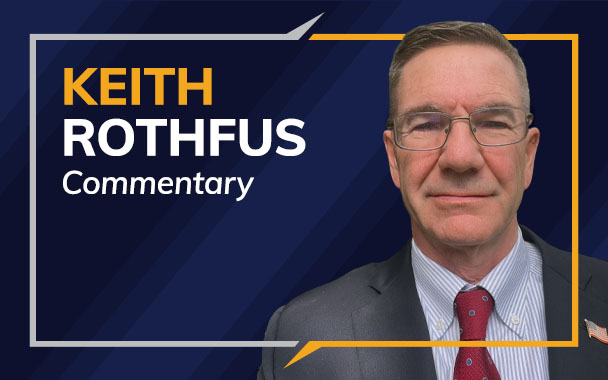
(Congressman Keith Rothfus served 3 terms in the U.S. House. He is a Notre Dame Law School graduate living near Pittsburgh where he and his wife raised their family.)